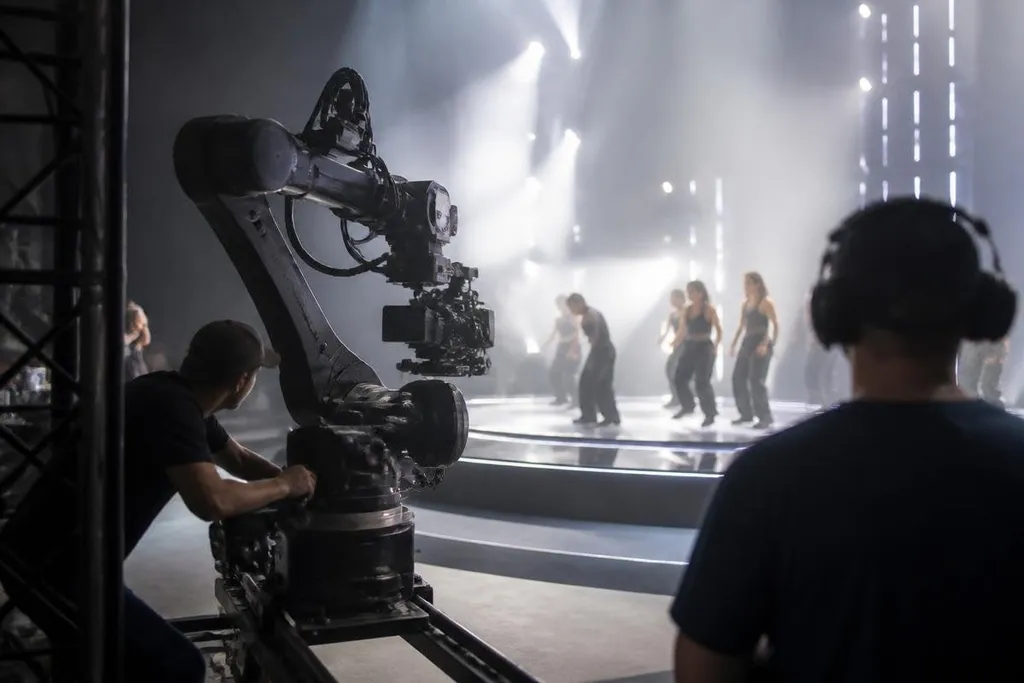
A robot in a film, theme park, concert, or live event has one job before it moves: keep the audience focused on the experience. The biggest gains in entertainment robotics come when a machine repeats a physical action safely, quietly, and on cue.
- Repeatable motion: the robot performs the same action without visible resets.
- Safer interaction: people can stand close without entering a risky work area.
- Better control: operators can change movement, timing, or sound during a show.
Motion that survives repetition
Entertainment puts robots under a different kind of pressure than a factory. A factory arm may repeat one task for a fixed group of workers.
A stage or attraction must run the same movement for many groups of visitors, often with little time between performances.
That makes repeatability a major measure of progress. A moving head, creature, or prop needs the same start position, speed, stopping point, and timing each time. Small errors can grow into visible faults when a sequence runs again and again.
The useful advance is better control of the whole motion. That includes motors, position sensors, software limits, and the operator interface. A designer can then change a movement without rebuilding the physical system, provided the robot's limits stay clear.
Quiet operation matters too. A motor or gearbox that sounds fine in a workshop may distract from dialogue or music in a dark room. Noise, heat, cable movement, and access for repairs belong in the design from the start.
Robots that work near people
Audience-facing robots need a different safety plan from machines behind a fence. The robot must account for people who stop, reach toward it, or move into an area the crew did not expect.
Sensors can help detect a person and slow or stop motion. That does not remove the need for physical limits, emergency stops, staff training, and a clear reset process. A sensor can miss a person, lose its view, or react too late for a heavy moving part.
The best systems keep the force and speed of each movement suited to the space. A small puppet mechanism near a child needs a different design from a large figure moving above a stage. The same control software cannot decide that difference on its own.
A stage robot can repeat a clean move and still fail when a performer changes position. Entertainment teams need reports that show the robot’s sensors, force limits, control method, and test setting, rather than only the finished clip. Robot24.com entertainment robotics reports can supply that record before the next test: how the robot responds when motion is not scripted.
Interaction beyond scripted motion
A scripted sequence remains useful because it is easier to test. The next step is controlled response: the robot detects a sound, gesture, position, or event, then selects from approved actions.
That response can make a character feel less fixed. It can also create new failure points. A camera may lose a face. A microphone may pick up crowd noise. A software update may change timing that worked during rehearsals.
Good interactive systems limit what the robot can do. Operators need a clear view of the current state, a way to stop motion, and a manual path through the show. The audience may see spontaneity, but the crew still needs control.
What remains unproven
Many entertainment robots look convincing for a short sequence. That does not show how the system handles a full day of performances, a hot venue, dust, spilled drinks, weak network signals, or a missed cue.
Cost also changes the decision. A custom robot may suit a long-running attraction with a repair crew. It may make little sense for a touring act that needs fast setup and low transport weight. The right machine depends on the venue, run time, staff, and repair plan.
I’d count a system as a real breakthrough only after it proves repeatable work in the place where people will pay to see it.
A practical buying check
Use these questions before you approve a robot for a show or attraction:
- Run time: How many hours can it operate before charging or cooling?
- Reset work: What must staff do after a missed cue or emergency stop?
- Safety space: How far can each moving part reach, and how is that area marked?
- Repair access: Can the crew replace motors, cables, sensors, or covers on site?
- Control loss: What happens if the network, tracking system, or main controller fails?
- Proof: Has the maker shown repeated operation in a venue like yours?
Entertainment robotics will move forward through machines that keep working after the audience arrives. The next useful proof is not a longer clip. It is a full schedule, a clear safety plan, and a repair log that shows what happened between performances.